Full story
1. Context and Intersectional Oppression
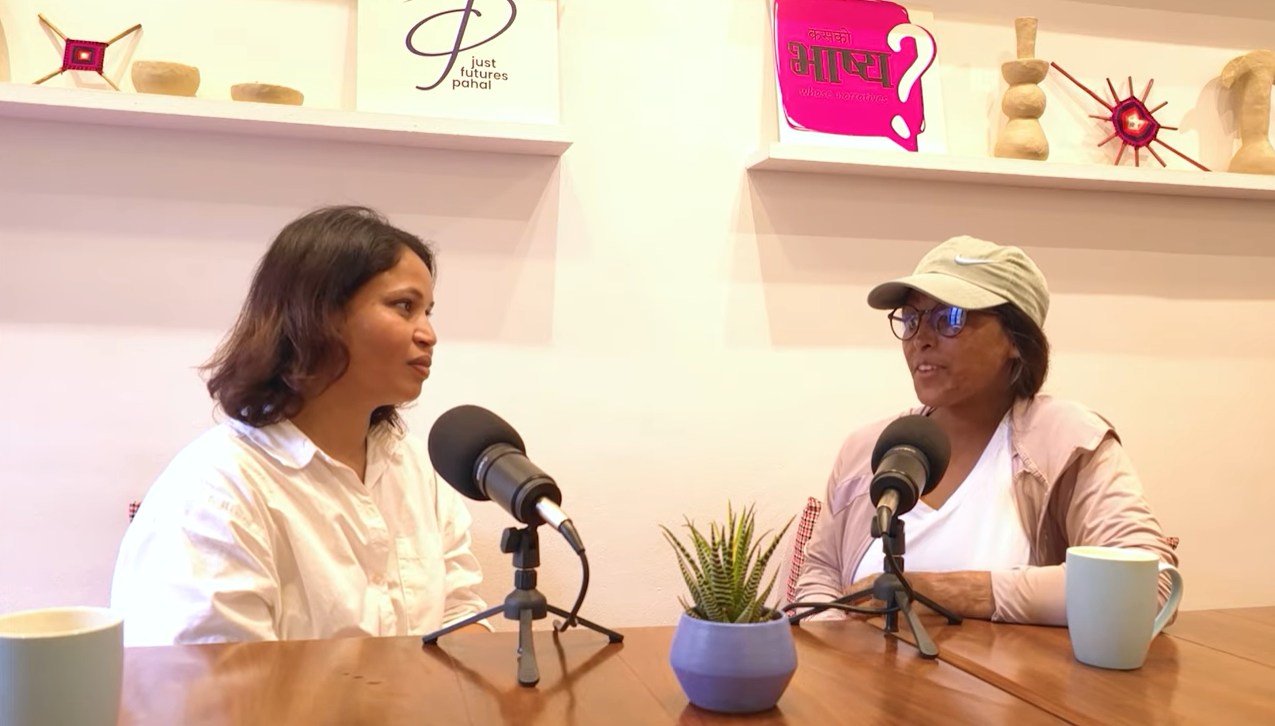
The second episode of the podcast Kasko Bhashya?, hosted by Gauri Nepali, centers on the lived experiences, struggles, and resilience of Dalit women. Guest speaker Dhana Pariyar carries multiple identities: student political activist, singer, advocate for persons with disabilities, and social campaigner.
Dhana emphasizes that when individuals experience layered/intersectional oppression—being marginalized due to caste, gender, and disability simultaneously—exclusion creates deep pain and righteous anger. She recalls participating in a judicial writing workshop where, despite raising her hand repeatedly, the organizers continuously denied her the microphone. She confronted the organizers to assert that excluding Dalit women with disabilities directly violates the core principles of social justice.
2. Delayed Identity Recognition and Structural Biases
Dhana critiques the formal education system and societal structures for concealing positive self-identity from marginalized children. She shares that she only fully realized and accepted her Dalit identity in 2076 BS, and her identities as a woman and a person with disability in 2078 BS. Prior to this, society imposed derogatory slurs (such as achhut, damai, or ashakta) without offering empowering framing in textbooks or classrooms. Furthermore, she highlights how religious texts and social practices perpetuate deep-rooted discrimination against persons with disabilities and Dalit communities.
3. Musical Journey, Discrimination, and Reclaiming Beauty Standards
Dhana’s passion for music began in her village in Surkhet after attending a festival featuring artists like Ramji Khand and Tika Pun. However, even attending as an audience member led to physical assault by crowd members who questioned why a disabled person was present in a public space. Supported by her family and English teacher, she later moved to Kathmandu, recorded a Deuda song, and gained media visibility.
Despite her talent, Dhana faced severe discrimination in the music industry. Stage show organizers cancelled her confirmed performance in the Far-West region, explicitly stating they preferred performers who met conventional physical beauty standards. Facing online harassment regarding her facial burn scars, Dhana underwent a long period of depression (2068 BS to 2077 BS) before actively deciding to reclaim her agency. She publicly posted her burn-scarred profile picture on social media, asserting her own definition of beauty and refusing to hide or yield to societal prejudice.
4. Historical Erasure and the Necessity of Self-Representation
Dhana points out that the historical contributions of Dalit women—such as in Yogmaya’s movement, the Anti-Rana battles, and the People's War (Janayuddha)—have been systematically erased from state records and academic histories. She contends that non-Dalit or privileged women cannot genuinely speak on behalf of Dalit women or women from remote regions like Karnali.
To change the prevailing narrative (bhashya), marginalized individuals must directly represent themselves, question authority, claim decision-making spaces, and resist oppressive structures